Virtual Data Room: The Ultimate Beginner’s Guide
In today’s digital business environment, organizations create, store, and exchange huge amounts of sensitive information every day. From financial data and contracts to legal documents, intellectual property (IP) and confidential business plans, data has become the sole asset driving decision-making and growth. However, with rising cybersecurity threats and increasing regulatory pressures, traditional methods of sharing documents, such as emails or basic cloud storage platforms, are no longer adequate. Companies require a more secure, controlled and compliant environment to manage critical information. This need has given rise to the Virtual Data Room (VDR), a secure digital platform specifically designed for highly confidential business operations such as mergers and acquisitions, fundraising, due diligence, legal matters, restructuring, IPOs and corporate governance. This comprehensive beginner’s guide explores the history of data rooms, the evolution of VDRs, their main features, the key security aspects and why Right2Data VDR stands out as one of the most secure and affordable VDR options in India today.
The History of Virtual Data Rooms
Before the digital age, companies relied on physical data rooms, secured locations where sensitive files were stored in cabinets and boxes for deal participants to review. During mergers and acquisitions or legal audits, lawyers, investors and advisors would travel to these rooms, manually review documents, request photocopies, and make notes under strict supervision. Although this method ensured physical security, it was slow, inconvenient and extremely costly. In large transactions involving multiple bidders from different countries, conducting due diligence across physical rooms became practically impossible.
As technology advanced in the early 2000s, companies began scanning files and sharing them via email or CD drives. While this was faster than visiting a physical data room, it created a new set of problems. Emails could be hacked or forwarded accidentally and once a document was shared digitally, there was no way to control what happened to it. Organisations urgently needed a digital solution that maintained the security and control of physical data rooms while offering the convenience of online document sharing. This need led to the creation of early Virtual Data Rooms.
The first generation of VDRs offered password-protected online portals where companies could upload documents for buyers or auditors to review. These VDRs were hosted on private servers and provided basic access control, but their speed, user experience and pricing were not ideal. Over time, with the rise of cloud computing, cybersecurity advancements and global business operations, VDRs have evolved into full-fledged cloud platforms capable of handling complex workflows with maximum security and efficiency. Today’s Cloud VDRs, such as Right2Data VDR, provide enterprise-grade protection, advanced user permissions, real-time analytics and seamless access from anywhere in the world.
Evolution of VDR Providers in India
The need for Virtual Data Rooms has grown significantly because business operations have transformed dramatically in recent years. Cyber threats are rising at an unprecedented rate, with ransomware attacks, phishing attempts and insider data leaks becoming increasingly common. Sensitive documents that once lived in physical folders now move through multiple devices, networks and teams. Traditional cloud storage platforms lack the ability to restrict document sharing, trace user activity, or ensure compliance with strict privacy laws.
Remote and hybrid work models have further accelerated the adoption of VDRs, as teams now collaborate across cities, countries and continents. Documents must be accessible around the clock without compromising security and a VDR enables exactly that. Additionally, corporate transactions such as mergers, acquisitions, fundraising, insolvency processes and litigation require large volumes of confidential documents to be shared with multiple parties simultaneously. Managing such complex workflows on email or basic cloud storage often results in delays, version conflicts and security violations.
Governments and regulatory bodies have also introduced stricter laws around data privacy, such as ISO 27001 and India’s DPDP Act. Companies that fail to maintain compliance risk heavy penalties. A Virtual Data Room ensures adherence to these standards through its built-in security mechanisms, audit trails and controlled access structure. In short, the modern business world demands a solution that blends security, speed, control and transparency, as the VDR is built precisely for this purpose.
The features of a Virtual Data Room
A Virtual Data Room is fundamentally a secure, centralised online repository where sensitive documents can be stored, managed, and shared with authorised users under strict permission controls. Unlike traditional cloud storage platforms, which focus on general file sharing, a VDR is specifically designed for confidential workflows where precision, compliance and control are essential.
At its core, a VDR functions as a structured and monitored environment with a layered security architecture. Documents are stored in encrypted cloud storage, organised into indexed folders and presented through a secure document viewer that restricts unauthorized copying or downloading. Administrators can define detailed access permissions for each user and folder, determining who can view, download, upload, print, or screenshot documents. This level of granular control is vital in sensitive transactions where different stakeholders must only see information relevant to them.
A VDR also offers real-time activity tracking, allowing administrators to monitor every action taken inside the data room. This includes login history, time spent on each file, attempted downloads, modifications and suspicious behaviour. Such transparency is invaluable during due diligence, legal proceedings and investment audits, as it helps companies understand what information stakeholders are reviewing and whether any risks exist. Modern VDRs also integrate advanced technologies like artificial intelligence for threat detection, automated indexing for document organisation and secure cloud hosting for maximum reliability.
Basic Security Requirements of a High-Quality VDR
Security is the most critical aspect of any Virtual Data Room. A professional VDR must meet strict global security standards to protect sensitive data from cyberattacks, internal misuse, and accidental exposure. The foundation of a secure VDR begins with encryption; data must be encrypted during upload, transfer, storage and viewing. AES-256-bit encryption has become the global benchmark for protecting data at rest, while TLS 1.3 ensures strong protection for data in transit.
In addition to encryption, a secure VDR must implement multi-factor authentication, requiring users to verify their identity using OTPs, emails, or authentication apps. This prevents unauthorized access even if credentials are compromised. Role-based access control (RBAC) is another essential component, allowing administrators to restrict user actions such as downloading, printing, copying, or forwarding files. A VDR must also maintain detailed audit logs that record every activity in chronological order, ensuring full traceability for compliance and risk management.
The secure document viewer is one of the most important features that differentiates a VDR from regular cloud storage. It prevents copy-paste actions, disables printing unless permitted and restricts screen captures by applying dynamic watermarking. Device and IP restrictions further enhance security by ensuring users can only access the data room under approved conditions. To meet compliance standards, the VDR should run on ISO-certified cloud infrastructure and align with privacy laws.
How a VDR Keeps Your Data Safe
A Virtual Data Room protects data through a multi-layered security approach that begins the moment a document is uploaded. Every file is automatically encrypted before storage and remains encrypted throughout its life cycle. When users view documents, the VDR decrypts them only temporarily within a secure environment that blocks extractions such as screenshots, downloads, or copying. This ensures that even if someone attempts to misuse the content, the system prevents it or records the attempt in the audit trail.
The platform continuously monitors user behaviour using automated systems that detect unusual activities such as repeated login failures, access attempts from prohibited locations, or excessive downloads. If abnormalities are detected, the VDR triggers warnings, temporarily locks the account, or alerts administrators instantly. Time-bound access links ensure documents are not accessible indefinitely, reducing long-term exposure risks.
A modern VDR also protects data through geographically distributed cloud storage and regular encrypted backups. Even in cases of server failures or natural disasters, the system ensures data remains accessible without loss. This resilience is essential for businesses undergoing acquisitions, litigation, or fundraising, where document availability must be guaranteed under all circumstances.
Right2Data High Security VDR
Among modern Virtual Data Rooms, Right2Data VDR stands out as one of the most secure and advanced platforms available in India and South Asia. Its security architecture is built on global standards, offering strong multi-factor authentication, end-to-end encryption, and a highly controlled access environment. Right2Data implements OTP-based authentication for every login, ensuring that even internal team members undergo strong identity verification before accessing sensitive information.
Right2Data’s permission system offers precise control over who can view, download, print, or upload documents. Administrators can enforce a strict view-only mode, activate screenshot protection and apply dynamic watermarks containing user-specific fingerprints such as their name, IP address, and timestamp. This discourages data leaks and provides immediate traceability in case of misuse.
The platform is hosted on an ISO 27001 and SOC 2-certified cloud infrastructure of Microsoft Azure server, ensuring compliance with international privacy standards. It uses powerful encrypted cloud storage systems and real-time monitoring to detect unusual activities. Right2Data’s document viewer is one of the most advanced and secure in the industry, while maintaining excellent readability and speed. The user-friendly, time-tested design ensures fast onboarding, while its constant monitoring provides peace of mind for critical business transactions.
Right2Data is the most affordable VDR in India and provides military-grade security, making it ideal for startups, SMEs and even large corporations.
To know more about Right2Data’s Virtual Data Room (VDR), please refer:
Table of Contents :
Important links :
Recent Blogs :
-
M&A Due Diligence : Mergers and Acquisitions and It's Due Diligence in 2026
-
 Top 10 Virtual Data Room Features Every Start-ups Needs in 2026
-
 Secure Room for Critical Transactions: Why Right2Data VDR Is the Trusted Secure Data Room for High-Risk Transactions
-
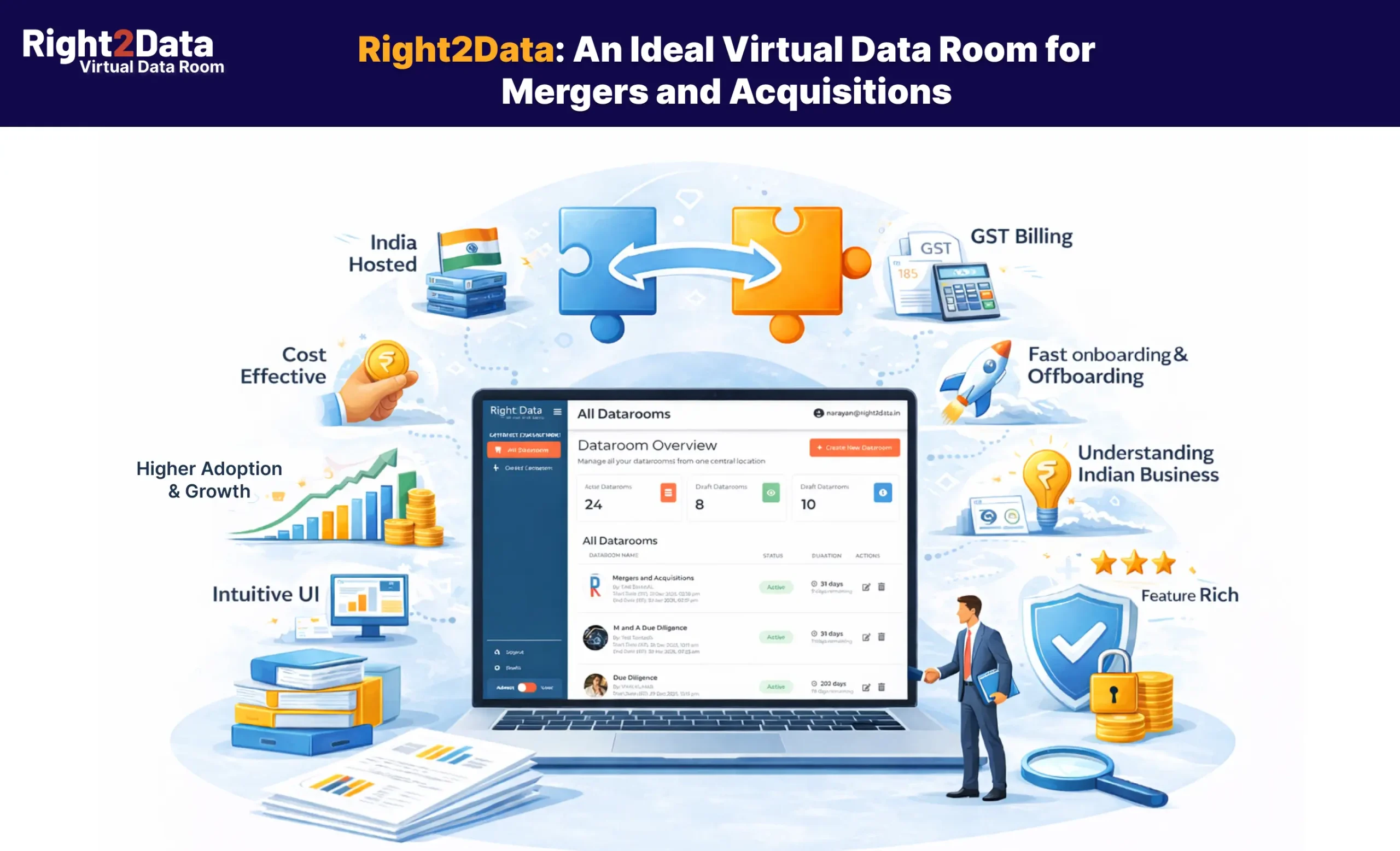 Right2Data: An Ideal Virtual Data Room for Mergers and Acquisitions